




Ursula Kemp, 1977
Lesson 14
REVIEW:
We covered in detail the background of the Book of James and saw something of James, the man behind the Book. We saw the general Outline of the Epistle and its key concepts. Then we examined the first three verses: verse 1, the SALUTATION, verse 2, ATTITUDE IN TESTING, and verse 3, the REASON FOR TESTING. Let's see how well you remember the teaching of those three verses. Close your Bible and your notebooks!
- What was the relationship of James to Jesus in the spiritual realm, as James saw it? (One of slavery to God and the Lord Jesus Christ.)
- What does this term imply? (Ownership on the part of God; duties on the part of the slave, unquestioning obedience, loyalty, total submission.) (Pride of service, an honor, privilege.
- Who, besides James, used that term? (Moses, the Patriarchs, Samson, Hannah, Mary, David, Simeon, Paul, Peter, Jude, etc.)
- What is rather unusual in this salutation? (It is a secular greeting.)
- What two other places in the New Testament is this form of greeting used? (In Acts, in a letter sent by the Roman officer, Claudius Lysias to Felix; in a letter stating the decision of the first church council over which James presided.)
- Whose attitude in testing should the believer emulate? (That of Christ.)
- Why should the believer's attitude be one of joy while he is under pressure? (Because of the end result of testing.
- What reason does James state for the believer's testing? (The vindication of the believer's faith.)
- What Christian virtue is to emerge in testing? (Patience.)
- Whose patience is cited as an example in this Epistle? (Job's.)
- What do we encounter as we look behind the scene of testing? (The Holy War of the Ages.)
- Where does this conflict take place? (In man's soul.)
- What spirit-being is actively involved and vitally interested in the outcome of the testing? (Satan.)
- Give me two synonyms that best portray the biblical meaning of the word "patience." (STEADFASTNESS, PERSEVERANCE.)
- On what should we focus in testing? (On the result rather than the means.)
OUTLINE: JAMES 1
I. DETAILED OUTLINE OF CHAPTER ONE
Verses 1-12: The trial of faith.
Verses 13-21: The progression and conquest of sin.
Verses 22-25: The doers and hearers of the Word.
Verses 26-27: The difference between religion and faith.
II.STUDY AND TEACHING OF JAMES 1:4-12
APPROACH:
Perhaps it is because the Book of James is so intensely practical that it demands application in our own lives. For example, did you experience a trial of your own faith--to a greater or lesser degree this past week? Were you able to maintain spiritual equilibrium in spite of the problems you encountered? Did the testing of your faith produce PATIENCE (STEADFASTNESS, PERSEVERENCE) in you, or did it produce the usual irritation, irritability, impatience, annoyance or give-up-itis? Did you snap at others in your periphery, or was your joy and peace a source of amazement to those who watched you?
Not only is our attitude in testing known to God (Heb. 4:13), but it will also be evidenced by those around us (I Cor. 4:9). Thus, the witness of our life is as important as the witness of our lips. In fact, THE MANIFESTATION OF OUR FAITH GIVES CREDENCE TO THE PROFESSION OF OUR FAITH! Conversely, OUR REACTION TO TESTING WILL NEUTRALIZE OUR TESTIMONY! We will see some more of this as we continue in our study of this Epistle.
I. DETAILED OUTLINE OF CHAPTER ONE (Verses 1-12)
By way of summary, we noted last time that verse 1 was the salutation; verse 2 presented the right attitude in testing, and verse 3, the reason for testing.
JAMES 1:1-12: THE TRIAL OF FAITH:
By way of preview, and still in this same section (THE TRIAL OF FAITH), we are going to see the following subjects developed:
Verse 4, the result of testing.
Verse 5, 6a, a prayer principle.
Verse 6b, an illustration from nature.
Verse 7, a prayer principle ignored.
Verse 8, a parallel from life.
Verses 9-10, focus on spiritual and material riches.
Verse 11, illustration and application.
Verse 12, the reward for testing endured.
Let us complete this section as long as the outline is fresh in our minds! To pick up continuity, we will read again verse 3, and tie it in with verse 4. We saw that the reason for testing is the production of unswerving constancy in our Christian lives. The means of testing may vary, but the result should be patience and its byproducts.
II.STUDY AND TEACHING OF JAMES 1:4-12
VERSE 4: THE RESULT OF TESTING
James speaks of allowing patience to have her perfect work. What is that work? That we may be "PERFECT AND ENTIRE." What is meant by these two words? (Note: this falls into the category of INTERPRETIVE QUESTIONS.) At this point you refer to your study helps, the concordance or lexicon. Note the words in the original; they are τέλειος, TELEIOS -- "brought to completion, fully developed"; "perfect"; ὁλόκληρος, HOLOKLEROS --"morally perfect, faultless, blameless, whole in every part"; "entire". They do not speak of sinless perfection but of SPIRITUAL MATURITY AND COMPLETENESS; such completeness as to leave NOTHING LACKING IN THE LIFE!
A "TELEIOS PERSON" is one who has reached spiritual adulthood, one who measures up to God's expectations of him! A person of this caliber does not permit the presence of sin to neutralize his Christian life because he conquers sin! His vertical relationship (to God) is vital and sound in every aspect, and his horizontal relationships (to mankind) are above reproach. As a result, he is "deficient in nothing"(λείπω, LEIPO). That is, he comes closer and closer to the divine standard--the Christ-like life.
VERSE 5, 6a: A PRAYER PRINCIPLE
As we read verses 5 and 6a, you will note a seeming paradox. We just learned of "wanting nothing"; now we learn of the likelihood of a believer lacking something--wisdom! What James is saying here is that no deficiency exists in the life of a mature believer, BUT there exists a very basic and primary lack in the life of the new or growing believer. That lack is the application of knowledge to experience! Particularly is this true in time of testing.
When you are emotionally enmeshed in a problem you cannot look at it objectively. You may know a pertinent verse or doctrine, yet you are not sure of its application. Or else, you may misapply what you know! There is a perfect solution; you are to cast all your care on Him Who cares for you (I Pet. 5:7). Go to your heavenly Father and ask Him for help.
Next follows an important prayer principle: ASK OF GOD, IN FAITH, NOTHING WAVERING (Cross ref. Matt. 21:22; I John 5:15). Why can you ask Him for wisdom and fully trust Him for its supply? Why need you not hesitate or be embarrassed to ask Him again and again to make up your lack? Not only because He is omnipotent God, but also because He gives generously. It is God's nature to give ("UPBRAIDETH" --ὀνειδίζω, ONEIDIZO, "to reproach, to give without regret"). God knows HOW to give good gifts; you should know HOW to ask for them (Matt. 7:11; John 15:7)! He guarantees their supply; you need only specify the amount!
"LET HIM ASK IN FAITH, NOTHING WAVERING!" That means you ask believing, by means of faith. The Greek word for "wavering" is διακρίνω, DIAKRINO and means "to judge diversely, hesitatingly." It refers to INDECISION. Indecision is a well-known deterrent of action! It caused the Israelites to "halt (leap) between two opinions" (I Kgs. 18:21); should they serve God or Baal? In the meantime, the Land suffered a terrible drought (cf.Jas.5:17). Doubtless, James had this incident in mind when he connected this prayer passage with Elijah! James says to us, "ASK WITH AN UNDIVIDED MIND!"
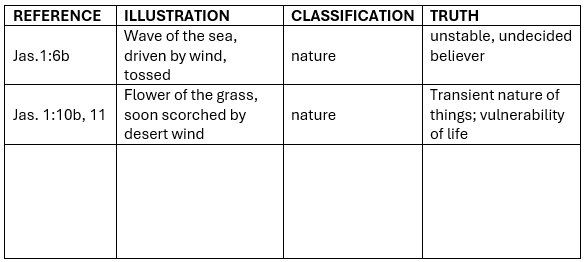
VERSE 6b: AN ILLUSTRATION FROM NATURE
The break-down of faith. is likened to the wind-driven and wind-tossed wave of the sea. Characteristic of the illustration is the believer who is "tossed about by every wave of doctrine" (Eph. 4:14). He lacks stability, peace of mind; he is undecided, unsettled, agitated and restless. Such a one cannot experience joy under testing. His mind is in conflict, and he will be troubled and all washed up!
VERSE 7: A PRAYER PRINCIPLE IGNORED
Unless you are fully convinced that you not only need the Lord's supply of wisdom but that you will indeed receive and put it to use in your life, don't bother asking for it! If given, such wisdom would be wasted on you, James is saying.
VERSE 8: A PARALLEL FROM LIFE
Note how these verses relate to each other: verse 6a ties in with verse 7; verse 6b with 8. The illustration James drew from nature (and he uses many of these) has its counterpart in real life; it is personified in the double-minded believer. Literally, the word should be translated "two-souled" (δίψυχος, DIPSUCHOS). The two-souled person is a walking disaster area. In his soul war two factions: belief and unbelief; trust and mistrust. He is an unbelieving believer, confused and at the mercy of indecision.
INDECISION IS THE BASIC PROBLEM OF ALL INSTABILITY. (The term "double minded" has its Hebrew equivalent in Psalm 12:2, where we read of a "double heart." In that context the "double heart" leads to hypocrisy in society.) This is not God's intention for the believer. He has given us a "SOUND MIND" (2 Tim. 1:7) and wants us to exercise "SOUND SPEECH that cannot be condemned" (Tit. 2:8). The believer is to be characterized by SINGLENESS OF MIND (Luke 11:34; Eph. 6:5)!
Watch for the contrast James shows us between the perfect and unchangeable Giver and the wavering petitioner (read vs. 6, 8, cf. 5,17)! INDECISION, INSTABILITY on the part of man; GENEROSITY, IMMUTABILITY on the part of God! We are told in Ephesians 5:1 that we should be imitators of God! In attaining Godliness (God-likeness), the closest you and I can come to imitating immutability is to have stability of soul!
VERSES 9-10: FOCUS ON SPIRITUAL AND MATERIAL RICHES
These two verses state the proper perspective of spiritual and material wealth. The "lowly brother" (impoverished, despised) may rejoice in his spiritual riches and in his exalted position in Christ. He is "rich in faith" (Jas. 2:5). On the other hand, the rich believer should consider his "low estate." He is totally dependent on the grace of God. He cannot rely on his wealth, for it may be wiped out in an instant. He is no better in the sight of God than his lowly brother. CHRISTINANITY KNOWS NO CLASS DISTINCTIONS OR BARRIERS (Gal. 3:28). This is one reason why the sin of partiality, in James 2, is so gross!
VERSE 11: ILLUSTRATION AND APPLICATION
Again, note James' poetic soul. He vividly pictures the INSECURITY OF FINANCIAL SECURITY! He cites another illustration from nature, one with which his recipients were familiar: the Simoon (hot, dry, sand storm of the desert). After the rain showers tender green shoots of grass sprung up in the desert regions, and among them, wild flowers. Then came the scorching desert wind which left no trace of the vegetation that had only recently adorned the area.
What is James trying to put across to us? That nothing in this life will last. This is the essence of temporal things. To trust in these is utter folly! James tells us that our own lives are but vapor trails across the historical horizon (Jas.4:14); and the riches we accumulate with divine enabling are ours only on a loan basis (Job 1:21; I Tim. 6:7). God warned the Israelites to remember the Source of their riches (Deut. 8:14-17), and our Lord cautioned against the "deceitfulness of riches" (Matt. 13:22). Jeremiah admonished believers not to boast of their material possessions (Jer. 9:23), and Paul, against "trusting in uncertain riches" (I Tim. 6:17). Thus, it is not the possession of worldly goods which the Bible decries, but the trap they may become to us.
WHEN WE CONSIDER HOW FRAIL AND VULNERABLE WE ARE, AND HOW TRANSIENT THE NATURE OF EARTHLY POSSESSIONS, WE CANNOT BUT PUT OUR TRUST WHERE IT BELONGS--IN THE LIVING GOD! HIS IMMUTABILITY IS THE ANCHOR OF OUR STABILITY!
With that correct perspective of spiritual and material riches, we will say with Paul,
" ... we look not at the things which are seen, but at the things which are not seen; for the things which are seen are temporal; but the things which are not seen are eternal" (2 Cor. 4:18).
VERSE 12: THE REWARD FOR TESTING ENDURED
Were not the result of our testing sufficient incentive to maintain a heavenly view of earthly trials, the promised reward should be ample motivation for our steadfastness. I refer you back to Job. As God knew, and Job anticipated, the testing of Job proved that this man's faith in God was genuine (Job 23:10).
There is nothing like testing to bring out the true nature of a person. Even as metals are subjected to extreme stress to demonstrate their durability and reliability to function as called upon, so the believer's worth is manifest under adverse circumstances. Proverbs 24:10 says, "If thou faint in the day of adversity, thy strength is small."
Job was rewarded amply for his steadfastness; his former possessions were doubled, as was the replacement of the children he had lost (Job 42:12, 13). More than that, he earned a permanent divine citation in God's "Who's. Who." We are told to follow his shining example!
We may or may not realize tangible rewards in this life, but we can realize the reward of joy and contentment. And we can anticipate rewards in eternity. This is the type of reward mentioned in James 1:12. It is called here the "CROWN OF LIFE," which the Lord is said to have promised to them that love Him. Do you see now why Romans 8:28 applies?
Exactly what is this CROWN OF LIFE, and where is this promise of the Lord's recorded? There is no direct statement to that effect in the Gospels, or in the Old Testament, for that matter, regardless how hard you may look for it. But there is the promise of life abundant and life eternal to come. Life lived to the fullest is life lived in conformity to the will of God as expressed in the Word of God. To love the Lord with all our heart and mind and being calls for complete obedience. Jesus Christ defined the mechanics of love in that way (John 14:21, 23). Those who qualify will have earned the CROWN WHICH CONSISTS OF LIFE (literal sense of the phrase).
The crown itself is symbolic of our exalted position. It speaks of the imparting of beauty, honor, splendor. You see, when we deal with eternal things our finite, temporal understanding is scarcely adequate to describe what no man has ever seen. To put across to us the general idea of eternal reward, the Bible must present divine truth within our frame of understanding. One thing we know, GOD'S REWARDS TO US IN ETERNITY WILL SHOW (I) WHAT GOD DID FOR US IN TIME, AND (2) TO WHAT DEGREE WE HAVE UTILIZED HIS GRACE.
(For a more thorough understanding of the various ways the word "CROWN" is used in Scripture, I recommend the use of a concordance. You may want to list them and categorize them some day.)
Take a last glance at verses 3-12. They present a panorama of the believer's pilgrimage from this life unto the life that is to come. Here is the pilgrim's progress: upon salvation, his faith is tested. He becomes mature. He learns to depend upon God for his every need, and he becomes preoccupied with heavenly things. Eventually he must cross the Valley of the Shadow of Death. But look where he is heading--to his eternal Home and his own coronation and His Lord's praise, "Well done, thou good and faithful servant!".
In the meantime, we must return to the grim reality of this life and the progression and conquest of sin. This is a vast subject in itself, and we will take it up in our next lesson.
PRACTICAL EXERCISES
Lesson 14
ILLUSTRATIONS IN THE EPISTLE OF JAMES.
In James 1:6, 10b, 11, James uses illustrations from nature in order to portray biblical truths. Read the entire Epistle and list or chart every illustration you find, from nature, life, agriculture or from a precedent set in history. (See sample Iisting.)