





Ursula Kemp**, 1977**
Lesson 8
REVIEW:
In our study of the BASIC PRINCIPLES OF HERMENEUTICS, we noted three general and six biblical laws which must govern correct investigation and interpretation of Scripture. Can you remember and name these principles, as well as categorize them according to these clues?
- Accepted by the fundamental, evangelical Christian who never doubts their veracity nor attempts to find an explanation. (The supernatural in Scripture; biblical law)
- Helpful in determining the proper frame of reference of a passage. (Literary style; general law)
- Principle helpful in discovering the gradual unfolding of God's plan. (Progressive revelation; biblical law)
- Recognized by the Spirit-filled believer as essential to maximum spiritual perception. (Spiritual factor; biblical law)
- Principle of hermeneutics required for discovering the deeper meaning of a passage. (Theological exegesis; biblical law)
- Indispensable to finding the context, historical, cultural setting and events of a passage. (Grammatical exegesis; general law)
- Hermeneutical principle which allows the Bible to interpret itself. (Self-interpretation; biblical law)
- The harmony of the Old and New Testaments as centered in Jesus Christ. (Unity of the Scriptures; biblical law)
- Essential to discerning the expression of thought and meaning in a Bible passage or concept of antiquity. (Word study; general law)
OUTLINE:
I. TYPES OF WORD STUDY
A. WORDS WITHIN A SENTENCE
- Their structure.
- Their relationships.
B. INDIVIDUAL WORDS
- Their relationships.
- Their inflections (changes undergone to show relations of case, number, gender, person, tense, etc.)
- Their grammatical use (nouns, pronouns, verbs, adjectives, conjunctions, etc.)
- Their literary style (literal or figurative use, comparisons, repetitions, logical progressions, etc.)
- Their meaning (in context).
(Some of these will become evident in this study.)
II. PROCEDURE
A. OVERVIEW OF A PASSAGE
B. FOCUS ON A VERSE
C. FOCUS ON A WORD
APPROACH:
As we have already observed, in-depth Bible study involves more than reading or casually investigating a passage; it requires TIME, PATIENCE, SELF-DISCIPLINE and DETERMINATION on the part of the Spirit-filled believer. In thorough Bible study the student examines in detail each verse for sentence structure, relationship of words, and meaning of words. Each word must be analyzed in its relationship to the other words in a sentence; each word must be evaluated as to its own merit and importance.
Now to most of us grammar is an "ugh-shudder-proposition." Nevertheless, it plays an important role in the correct analysis of the Word of God. Thus we need to brush up on our grammar, long-forgotten with a sigh of relief, as we take a deep plunge into the water of the Word and come up with greater insight than we had before. Are you ready?
I. TYPES OF WORD STUDY
The last rule of hermeneutics, which we mentioned in our review quiz, was the general rule of WORD STUDY. There are TWO TYPES OF WORD STUDY: (1) the study of words within the UNIT OF THE VERSE OR SENTENCE; (2) the study of INDIVIDUAL WORDS.
A. WORDS WITHIN A SENTENCE
Even as individual pearls strung together make up a necklace, or links make a chain, so individual words strung one upon another form a sentence. We are often guilty of choosing our words carelessly. By so doing, we may hurt or offend others, intentionally or unintentionally. On the other hand, the words of Scripture are carefully chosen by God the Holy Spirit Himself. Each word is intended to express a specific thought or message, and each word conveys a precise meaning. It remains for us to determine what that meaning is.
Since our entire study course concerns the Holy Scriptures which are the WRITTEN WORD OF GOD, containing the revelation of the LIVING WORD, JESUS CHRIST, let us concentrate on the word "WORD" as found in John 1:1. As we read this verse, let us savor each word.
"IN THE BEGINNING WAS THE WORD, AND THE WORD WAS WITH GOD, AND THE WORD WAS GOD" (John 1:1).
In a study of this verse, which we will undertake later in this lesson, we would note the structure of this statement. By that, I mean that we would look into the basic relationships between the words and phrases found here, how they are arranged under the direction of the Holy Spirit, and why. Furthermore, we would watch for the arrangement of this verse within this passage, chapter and book.
B. INDIVIDUAL WORDS
We might pick out any or all of the words of John 1:1, but the most prominent one in context will serve as a sample of what you might pursue on your own time. Again, the selection we have made is the term, "WORD."
What is our present frame of understanding concerning this word? We have examined it in its setting of Psalm 19, where a variety of designations shed light on the many aspects and essence of the Scriptures. Here, however, the term has a different meaning altogether; it does not refer to the written Record but to the LIVING REVELATION OF GOD IN CHRIST! In order to study this word, we must follow certain prescribed steps.
II. PROCEDURE
A. OVERVIEW OF A PASSAGE
The first step is vital: NEVER ATTEMPT TO INTERPRET A VERSE BY LIFTING IT OUT OF ITS PROPER CONTEXT! Rather, GET AN OVERVIEW OF THE PASSAGE YOU ARE TO EXAMINE!
John 1:1 is the first verse of an introduction to the Gospel of John. This introduction, or prologue ends with verse 18. (If need be, consult a sound Bible Handbook or Bible Dictionary for the basic breakdown of each of the books in the Bible.) The prologue states the pre-existence of Jesus Christ in eternity past, and it identifies Him as the Creator of the universe Who became Man in order that He might reveal God to mankind. Compared to this profound truth, the introduction of John the Baptist, and the saved and unsaved of mankind fade into insignificance. Jesus Christ, the Source of all life--spiritual and physical--was manifested, the True Light in a world of darkness, to light every man's way back to God and potential spiritual regeneration!
With this setting of verse 1 firmly in mind, we may take the second step: we may narrow down our observation to a study of John 1:1.
B. FOCUS ON A VERSE
There is no way that I have found which is more helpful to the Bible student than that of charting or diagramming a verse. You need not come up with a complex chart; a simple diagram will do nicely. It is the most effective means of organizing your thoughts and recording your findings in a concise manner. Besides, writing these things down helps you to remember them.
(1) BEGIN BY WRITING OUT THE VERSE YOU INTEND TO STUDY, ALONG WITH ITS REFERENCE.
John 1:1: "In the beginning was the Word, and the Word was with God, and the Word was God."
(2) DISSECT THE VERSE AND DRAW A STRUCTURAL DIAGRAM. (Keep it simple.)
Observe the natural division of this verse. Into how many units or sections does it fall? (Three.) Your structural diagram should show these separate phrases. Note example!
IN THE BEGINNING WAS THE WORD
AND THE WORD WAS WITH GOD
AND THE WORD WAS GOD.
(3) UNDERLINE, CIRCLE OR COLOR THE KEY WORDS. Which would you consider to be the most prominent? ("Word," mentioned three times. "God," mentioned twice.)
(4) Arrange according to structure of the verse, writing parallel or repeated thoughts, words and phrases under each other as shown. Now proceed to bracket and label these for clarity; underline connectives!
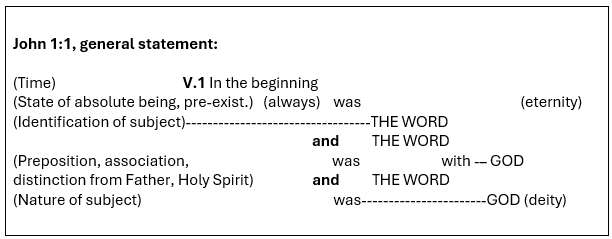
(5) Additional things to note in STRUCTURAL DIAGRAMS:
1.Modifying (qualifying) words or phrases. (Example: Gal. 3:26-- "children of God BY FAITH IN CHRIST JESUS"; phrase; Matt. 7:24, 26-- "the wise man, foolish man"; words.)
2.Contrasts; similarities. (Example: Similarities among apostates-- Jude 12, 13, 16; contrasts: faithful believers -Jude 17, 20-23.)
3.Major points; sub-points of passage. (Example: Major points, Psa. 19 -the two-fold revelation of God; the effect of the Word of God; minor points: illustrations, prayer.)
4.Commands; exhortations; examples. (Example: Commands, Gal. 5:16-- "walk in the Spirit!" Exhortation, Heb. 4:16-- "Let us!" Examples, John 3:15-- "As Moses, even so the Son of Man.")
5.Reasons; results, i.e., cause and effect. (Example: Psa.91 :14-- "Because, therefore".)
KEEP IN MIND THAT YOU ARE WORKING WITH THE TRANSLATION OF THE TEXT. IDEALLY, THE STUDENT SHOULD WORK WITH THE ORIGINAL LANGUAGES OR WITH STUDY HELPS. HOWEVER, YOU CAN GAIN TREMENDOUS INSIGHT THROUGH CONCENTRATED STUDY OF THE ENGLISH BIBLE!
C. FOCUS ON A WORD
Now we are ready to take the word we have selected and examine it in detail. "WORD," in the Greek text is "LOGOS." Derived from the root "LEG," it is found in the verb "LEGO" (Λόγος; λέγ; λέγω). Originally, this verb meant "to lay, gather, pick out or up," i.e., "to gather words, to put words together." Eventually, it came to mean "to speak."
AS THE GLORY OF GOD IS THE OUTER MANIFESTATION OF GOD'S INNER ESSENCE, SO THE LOGOS IS THE OUTER MANIFESTATION OR EXPRESSION OF GOD'S THINKING!
"LOGOS" had a double meaning of "thought" and "speech." THUS THE LOGOS IS THE EMBODIMENT OF word and idea, yes, of the INVISIBLE GOD HIMSELF. John uses the same word in John 1:14, where he reenforces this concept. Putting both verses together, we get the picture of Jesus Christ in eternity, and Jesus Christ in time, what He WAS--Eternal God, co-equal with the Father and the Spirit; what he BECAME (WAS MADE) --the Revelation of God's glory, the express image of His Person (Heb. 1:3), the God-Man! THOSE WHO HAD SEEN HIM HAD INDEED "SEEN THE FATHER" (John 14:9)!
"LOGOS" also conveys our Lord's mission (John 1:18 -- "the Son...hath declared him"-the Father cf., Heb. 1:1, 2).
Were we to study the second mention of the word "God," we would see that it is in the emphatic case; it could be translated "IS GOD HIMSELF." The Old Testament affirms this truth in Isaiah 9:6, where the Son is called "the Mighty God." (The first mention of the word "God" is preceded by the definite article "the" in the Greek text. It identifies the Person of the Father. The second time God is referred to there is an absence of the article. In the Greek sentence this denotes the quality of the Person of Jesus Christ, His nature and essence as God.)
The accidental discovery of the Dead Sea Scrolls shed new light on the INTERPRETATION of the original manuscripts. These valuable discoveries were applied to the principles of biblical HERMENEUTICS. Scholars concluded that the background for John's use of "LOGOS" has its roots in Judaism.
WE ARE LED BACK TO GENESIS 1:1: "IN THE BEGINNING GOD" --the self-existence of the GREAT I AM! (See also Isaiah 48:16 --the Trinity in the Old Testament.)
Genesis 1:3: "AND GOD SAID "-- אָמַר (amar), "to say, to lift up the voice." ONCE AGAIN, WE SEE THAT THE "WORD" (THE LOGOS) IS "THE DIVINE AGENT IN CREATION AND THE REVELATION OF GOD'S WILL TO MEN" (Unger's Bible Dictionary, p. 664).
Two more mentions of the LOGOS remain for us to see--I John 1:1 and Revelation 19:13. What we have here is a reiteration of John 1:1, the eternal existence of the Son of God-- "THAT WHICH WAS FROM THE BEGINNING"; the incarnation of Jesus Christ -- "THAT WHICH WAS SEEN, HEARD, LOOKED UPON AND HANDLED OF THE WORD OF LIFE."
Revelation 19:13 describes John's vision of the return of the Word as the Righteous Judge!
We cannot but come away from this WORD STUDY deeply impressed by THE GRACE and TRUTH personified in Jesus Christ. As He manifested the glory of the Father, so we should reflect the glory of our Savior! He left us an example to follow (I Pet. 2:21)! When He spoke, "all wondered at the gracious words which proceeded out of his mouth"(Luke 4:22). Our own speech (λόγος, logos) is to be "seasoned with grace" (Col. 4:6), "sound speech, that cannot be condemned" (Tit. 2:8)! BUT IS IT???
Let us draw from our study one final application. John commented that "THE WORD WAS WITH GOD" (John 1:1). He noted the close fellowship of the Godhead and the manifestation of the Father; it was so obvious that the Son had been with the Father (I John 1:2)! FELLOWSHIP WITH GOD REFLECTS IN OUR OWN LIFE-STYLE AND IN OUR WORDS. That was the case with Peter and John (Acts 4:13). The people marveled and "took knowledge of them, THAT THEY HAD BEEN WITH JESUS"!
We are to have fellowship with one another as well as with God (I John 1:3, 7). TIME SPENT WITH THE LORD IN HIS WORD IS NEVER WASTED! The world can and should take knowledge of you, THAT YOU HAVE BEEN WITH THE LIVING WORD THROUGH TIME SPENT STUDYING HIS WRITTEN WORD!
PRACTICAL EXERCISES
Lesson 8
FOLLOW ANOTHER TYPE OF WORD STUDY. USING ANY STUDY TOOLS TO WHICH YOU HAVE ACCESS, DISCOVER THE VARIOUS USES OF THE WORD "ALTAR" AS THEY APPEAR IN SCRIPTURE. (Try to use either biblical or your own vocabulary.) LIST IN SUMMARY FORM AND STATE REFERENCES.