



Ursula Kemp, 1977
Lesson 6
REVIEW:
What would you want to determine before you begin the actual study of a passage? (Its background, author and purpose.) We learned that Psalm 19 is one of the Davidic Psalms. How many did he write in all that are preserved in the Bible? (Seventy-three.) In order to understand the Psalms we must regard them as did the ancient Jews, as the Book of Praises--the Prayer Book and Hymnal of God's people. What other subjects does the Psalter contain? (The experiences, trials, triumphs of believers of past generations; also, great prophetic themes.)
What type of literature do we find in the Psalms? (Poetry.) How does the Hebrew style of poetry differ from our own? (It does not rely on rhyme or prose but on parallelism and rhythm of thought.) There are two types of parallelism, synonymous and antithetical parallelism. Synonymous parallelism emphasizes in the second or following lines any statement that was made in the first line; antithetical parallelism contradicts in the same stanza the initial statement.
We noted that Hebrew poetry is rich in imagery and often figurative. To interpret it accurately we must think within the framework of the ancients' understanding and know the customs of the time in which a passage was recorded. You can review your own notes for the interpretation of the first section of this Psalm, which we will complete today.
OUTLINE:
I. INTERPRETATION OF PSALM 19:7-14
II. SYNONYMS FOR THE WORD OF GOD
A. Their meanings.
B. Their implications.
APPROACH:
No one was more conscious of the importance of the Word than the Lord Jesus Christ. He frequently prefaced His sayings with the words, "It is written". He used quotations from Scripture to rebuke His enemies and teach His disciples. (Some day in your own study you may wish to trace His quotations in the Gospels.) One of the Lord's best-known quotations is taken from Deuteronomy 8:3 "...It is written, That man shall not live by bread (food) alone, but by every word of God" (Luke 4:4). To LIVE BY THE WORD OF GOD, you MUST KNOW IT! Psalm 19:7-10 teaches the essence of God's Word and its relationship to the believer. It is here we resume our study.
(Word of God, vs. 7-10). God's Word regulates the lives of His children!
AT THIS POINT WE WANT TO PICK UP THE CHART WE MADE ALREADY AND ADD THE
INTERPRETATION TO OUR PAST OBSERVATIONS. WATCH FOR THE MANY FACETS OF THE WORD, HOW THESE RELATE TO THE BELIEVER. HENCE THE CHOICE OF SPECIFIC VOCABULARY!
v. 7. The law (וֹבֿרָה, torah), meaning "direction, teaching of doctrine from the first five books of the Old Testament. These are also known as the "Books of Moses" or the "Pentateuch" (so named after the Greek πεντατευχοσ, pentateuchos, pente-five; teuchos --book), of the LORD (Jehovah; the name of God which stresses personal relationship) is perfect (spotless).
v. 8. The statutes (צִּרּוּדִים, piqqudim, meaning "charges, precepts, appointments"; pertains to the permanent regulations for social conduct of God's people, the Jews. Word occurs only here) of the LORD are right (upright), rejoicing (joy under pressure) the heart: the commandment (מִצְוהָ, mitsvah, meaning "order" in an authoritative or military sense; also rendered "precept") of the LORD is pure (unadulterated), enlightening (gives light to the eye; same concept as in Eph. 1:18) the eyes. (Spiritual perception.)
v 9. The fear (ירְִאָה, yirah, usually means "reverence" but in context pertains to the expression of God's nature in His discipline and judgment) of the LORD is clean, enduring forever: the judgments (מִשְׁצָּט, mishpat, meaning "rules of administration"; here describes how God performs His will) of the LORD are true and righteous altogether.
NOTE: "enduring forever"--the permanence of God's Word in spite of attempts to destroy or discredit it! NOTE DOCTRINAL EMPHASIS ON GOD'S JUSTICE AND RIGHTEOUSNESS AS FOUND IN THE WORD!
v.10. More to be desired than (purified) gold, yea, than much fine gold (cross ref. Psa. 119:127): Illustration: sweeter also than honey (virgin honey) and the honeycomb (droppings from a honeycomb).
NOTE APPLICATION HERE: HOW STRONG IS YOUR HUNGER FOR THE WORD, BELIEVER?
VERSES 11-14: THE EFFECT OF THE WORD OF GOD.
v. 11. Moreover by them (refers back to the judgments; connect "them" to judgments in verse 9) is thy servant (personal relationship to God) warned (cf., Psa. 119:11): and in keeping (obedience to the known will of God as revealed in His Word) of them is great reward.
EMPHASIS OF VERSE 11 TIES IN TO THE ENLIGHTENMENT MENTIONED IN VERSE 8!
NOTE: THE EFFECT OF THE WORD IN APPLICATION: THERE IS WARNING,
ENLIGHTENMENT AND REWARD FOR KEEPING THE WORD, BOTH NOW AND IN ETERNITY! ASK YOURSELF WHETHER THERE IS ANY AREA OF DISOBEDIENCE IN YOUR OWN LIFE!
v. 12. Who can (shall) understand errors (sins of ignorance)? Cleanse (cf., Psa. 119:9) thou me from secret (faults, implied; same concept as "unrighteousness" in I John 1:9; refers to unintentional sin--sins the new believer is not aware of as yet). v. 13a. Keep back (guard) thy servant also from presumptuous (premeditated sins); let them not have dominion (control) over (within) me:
NOTE: THE "OCTOPUS SIN", CALLED "THE SIN THAT SO EASILY BESETS" IN
HEBREWS 12:1! THE PROVERBIAL OUNCE OF PREVENTION IS FOUND IN THIS
PRAYER! Not that God would interfere with our free will, but that He would help us to be sensitive to His will!
v. 13b. Then shall I be upright (blameless because of forgiveness), and I shall be innocent (cleansed) from ("THE" not in better manuscripts) great (much) transgression (deliberate sin).
NOTE: SAME CONCEPT IS FOUND IN PSALM 119:11, 133.
v. 14. Let the words of my mouth, and the meditation of my heart, be acceptable in thy sight (to your face), O LORD, my strength (rock), and my redeemer.
DOCTRINAL EMPHASIS: OUR SALVATION IS THE INITIAL SOURCE OF VICTORY OVER SIN! Knowledge and application of the Word are of paramount importance in our daily walk with the Lord!
ASSIGNMENT: Look up all cross references given to see correlation of Scripture passages!
II. SYNONYMS FOR THE WORD OF GOD
In summary, let us note once more the various designations of the Word which are listed in the center section of this Psalm. What are these? And why did the Holy Spirit see fit to record them? To obtain the answers we must reexamine the words found here and elsewhere that are synonyms for the word "scriptures."
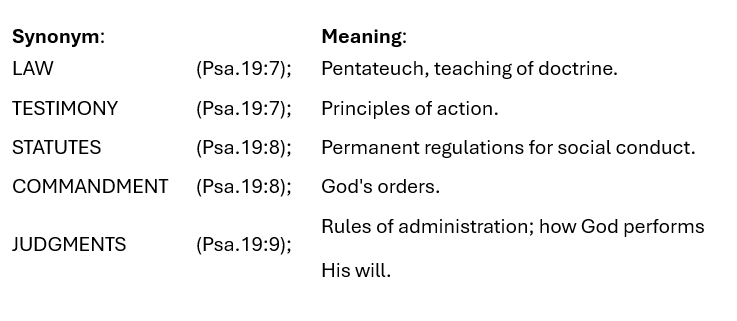
"The LAW" (v. 7.). Note that it is not the Law of Moses or the law of the land but the
LAW OF THE LORD, specifically, the TEACHING OF DOCTRINE IN THE
PENTATEUCH! Next, there is "the TESTIMONY" --general PRINCIPLES OF ACTION! Often we find ourselves in circumstances for which there is no clear-cut command or prohibition in Scripture. This is where the principles delineated in the Word of God must be applied. Example: There is no direct prohibition in the Bible relative to smoking. Should you, therefore, or should you not smoke? A similar problem of "questionables" plagued the Corinthians in Paul's day; should they or should they not eat foods sacrificed to idols? The problem can be resolved easily enough for them or for us by means of a Scriptural principle: "Give none offence, neither to the Jews, nor to the Gentiles, nor to the church of God" (I Cor. 10:32). Therefore, if your habit becomes a stumbling block to another believer, refrain from it--at least while you are in that person's presence. Likewise, if what you are about to do threatens your Christian testimony to the unbeliever, do not do it!
"The STATUTES" (v. 8)--permanent REGULATIONS FOR SOCIAL CONDUCT. These applied to the entire Jewish nation regardless of their salvation or lack of it. They regulated the nation's life. Their observance made Israel the envy of nations and advanced the Jewish people far beyond their time. Doubtless, it caused the Psalmist to exclaim, "Blessed is the nation whose God is the LORD" (Psa. 33:12). "The
COMMANDMENT"--HIS ORDERS demand an obedient response on the part of every believer. "The JUDGMENTS" --RULES OF ADMINISTRATION! These are the mechanics of HOW GOD PERFORMS HIS WILL! We can be assured at all times that divine justice and judgment emanate from an altogether righteous and holy God!
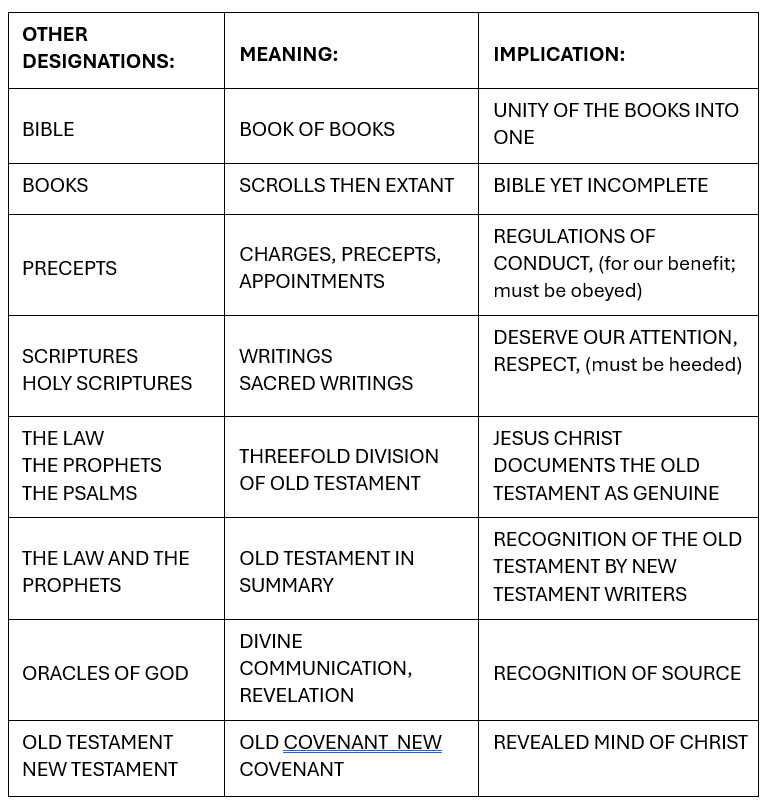
There are yet other synonyms for the Word of God. How can we discover what these are? Here a topical reference book such as a good Bible dictionary is invaluable; it will save you countless hours of digging. Look up the word "Bible" and list the additional terms and their references. See how these terms are used and what their meaning might be. Compile the information and jot it down in your Bible for quick and easy reference. You might do it in this manner. Head your project:
OTHER DESIGNATIONS, MEANING, IMPLICATION. (You already have the LAW, TESTIMONY, STATUTES, COMMANDMENT and JUDGMENTS.)
The most frequently used term is, of course, "the BIBLE." Although it is not a biblical term, it is nevertheless a very appropriate one. Derived from the Greek word βιβλος, biblos, Latin, biblia, it means "the BOOK OF BOOKS" and signifies the unity of the separate books which make up one complete and connected Book. It was named after the BIBLOS REED from which papyrus was manufactured and shipped to all the ancient world. Papyrus was the forerunner of our modern paper and made an excellent and durable medium for writing. The Greek Christians of the second century A.D. were the first to use the name, and it came down to us through the old French into the English as BIBLE.
Before the canon of Scripture was completed, the portions of God's Word then in existence were called "the BOOKS" (SCROLLS). Daniel referred to them in Daniel 9:2, when he wrote, "I Daniel understood by books (ףְּפָרִ֑ים, separim)..."
The term, PRECEPTS, occurs numerous times in Psalm 119. In this Psalm the translators have chosen to render the Hebrew word, צִּרּוּדִים, piqqudim, as "precepts"; in Psalm 19:8 they translated the same word "statutes." You will recall from your chart that the word means "charges, precepts, appointments," and it implies regulations of conduct. Needless to say, the conduct of God's own people in every generation should match their calling!
Another Hebrew word which has been variously translated is the word מִצְוהָ, mitsvah. In Psalm 19:8 it reads "commandment"; in Nehemiah 9:14, Isaiah 29:13; Jeremiah 35:18 and in Daniel 9:5, "precept." The meaning of this word is "order, command, a thing set up." A related Hebrew word is the word צָו, tsav -- "the command, thing set up." It occurs in Isaiah 28:10, 13 as "precepts."
This designation matches the Greek ἐντολή, entole, in Mark 10:5 and Hebrews 9:19, also translated "precepts."
What is the implication of this word? I think it is twofold: (1) rules are divinely set up for our benefit by a perfect Person; (2) rules are to be obeyed, not to be broken, particularly when they originate from the highest Authority in the universe!
The human writers of the New Testament referred to the Old Testament by these names: "the SCRIPTURES" (Matt. 21:42), Greek -- γραφή, graphe, from which we get such words as "graphic, autograph," etc. The word means "writings" or "anything that is written." The designation , "the HOLY SCRIPTURES" (ἅγιος, hagios--set apart, holy; γραφή, graphe-writings grammatical form in text -- γραφαῖς ἁγίαις, graphais hagiais; Rom. 1:2) shows that these are no ordinary writings but sacred literature! The implications here are unmistakable: because these are the sacred Scriptures they deserve our wholehearted attention and a reverential approach. Because they are sacred they are wholly trustworthy and authoritative. Because they are holy they are to be heeded!
That a distinction exists in the form of Old Testament Scripture is brought out in
Luke 24:44. The Lord Jesus Christ Himself documents this threefold breakdown as
He recognizes "the LAW" (νόμος, nomos, a reference to the torah), "the PROPHETS" (προφήτης, prophetes; this section includes the pre and postexilic writings known to the Jews as the נבְִיאִים nebiim), and "the PSALMS" (ψαλμός, psalmos; a collective term for the "writings" --Hebrew, וְֹהִלִּים kethubim or the poetical books).
At times the writers of the New Testament lumped up the Old Testament in the words "the LAW AND THE PROPHETS" (Acts 13:15). Paul labels the Word of God, "the ORACLES OF GOD" (λόγιον, logion; Rom. 3:2). "Logion" means "divine communication, revelation" and recognizes the Source of the Scriptures.
Today we accept the general division of the Bible into two parts, the Old Testament and the New Testament, or the Old and the New Covenants. The Old Covenant came by Moses; the New, by Jesus Christ (John 1:17). BUT WHETHER OLD OR NEW, THE WRITTEN WORD IS THE REVELATION OF THE LIVING WORD. IN ITS ENTIRETY, THE INSPIRED SCRIPTURES ARE PROFITABLE; THEY INSTRUCT US IN THE WAY WE SHOULD GO.
Implication: How often have you said," I wish I could read his/ her mind"? Well, you can know exactly what God thinks; "...WE HAVE THE MIND OF CHRIST" (I Cor. 2:16)! It remains for us to read and study the declaration of "his thought" (Amos 4:13)!
Suggested Chalkboard diagram: (If desired, add Hebrew and Greek words and references.)
SYNONYMS FOR THE WORD OF GOD: (Summary, refer back to chart of Psa. 19:7-
10).
PRACTICAL EXERCISES
Lesson 6
A. Look up the following references and add to your list of synonyms for the Bible the Scriptural ANALOGIES TO THE BIBLE. Next to these terms, state the obvious implications!
1.a).______________________________ (Psa. 119:105)
\ b).______________________________
2._________________________________ (Jer. 20: 9)
3._________________________________ (Jer. 23:29)
4._________________________________ (Mark 4:14)
5._________________________________ (John 12:48)
6._________________________________ (Eph. 6:17)
7._________________________________ (Jas. 1:22-25)
8._________________________________ (I Pet. 2:2)
B. Reevaluate the lessons you were taught thus far in this series! State which method, concept or instruction has been of the most value to you personally.