



Ursula Kemp, 1977
REVIEW:
Before we advance any further, let us retrace the ground we have covered thus far. In Lesson I we examined the reasons WHY each child of God (Gal. 3:26) should establish his (or her) personal time in the Word--to come to know God and His will for our lives. We saw that God authorized us in writing to search the Scriptures daily that our discernment might be sharpened, that we might have comfort and confidence, and that our lives might become Christ-like. This course should equip you with the basic tools and know-how towards personal Bible study. If you are properly motivated and prepared to search the Scriptures God will reveal Himself to you in the pages of His Word. However, divine revelation demands human response! You are held responsible to apply the truths you have learned to daily living. KNOWING COMES BEFORE PLEASING!
Lesson 2 moved from the WHY of personal Bible study to the mechanics; HOW do we go about it? The answer is threefold: EARNESTLY, PRAYERFULLY and IN THE FILLING OF THE SPIRIT! Periodically you might want to review the ten common-sense commandments for personal Bible study.
Lesson 3 concerned the DIRECTION OF BIBLE STUDY, that is, a definite plan and goal for you to follow. In that lesson we introduced the PROCEDURE of Bible study-- OBSERVATION, INTERPRETATION and APPLICATION. You learned what to look for as you read a passage, and you were shown how to chart your initial findings. From there, you could go into an in-depth study, examining every word closely, if you so desired. Be sure to familiarize yourself with the several steps involved in observation, interpretation and discerning the application. Remember, the old adage still holds: PRACTICE MAKES PERFECT!
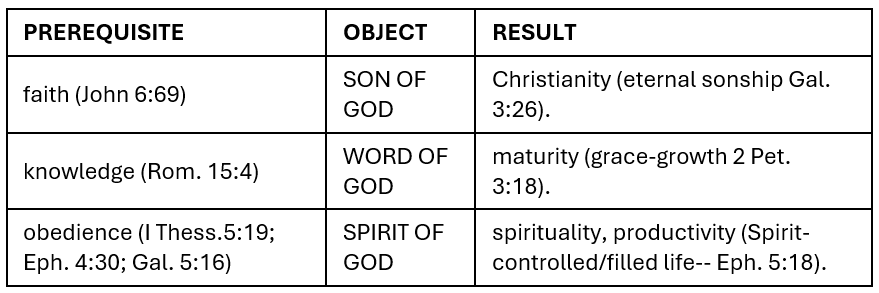
Also by way of review, I would like to suggest this simple diagram of CAUSE AND EFFECT in the believer's life. It deals with the Christian's relationship to the SON OF GOD, THE WORD OF GOD AND THE SPIRIT OF GOD, and it shows at a glance the positive results of the normal Christian life.
OUTLINE:
I. OUTLINING A PASSAGE
II. CHARTING A PASSAGE
III. APPLYING A PASSAGE
APPROACH:
God never leaves Himself without a witness, and therefore man is without excuse; he cannot plead mercy on the basis of ignorance. Open your Bibles to Romans 1:19 and 20:
"... that which may be known of God is manifest... for God hath shewed it unto them (mankind). For the invisible things of him from the creation of the world are clearly seen, being understood by the things that are made, even his eternal power and God-head; so that they are without excuse."
There certainly is no excuse for any believer to remain in abysmal ignorance concerning spiritual truths, particularly since we have easy access to the Word of God. The Bible testifies on its own behalf, and in this lesson we want to examine that recorded testimony. By way of introduction turn to 2 Timothy 3:16, 17 and, next, to 2 Peter 1:19-21.
The divinely inspired Scriptures proclaim their own profitableness and purpose in 2 Timothy, and their authenticity and impact are affirmed in 2 Peter. It remains for each believer to heed the content and counsel of the Bible! God's testimony during the pre and post-Canon periods of history are set forth in Psalm 19, a passage which we will take and scrutinize closely in this lesson and conclude in Lesson 5.
I. OUTLINING A PASSAGE
A. PROCEDURE
- Read entire passage for content!
- Read again and evaluate for continuity of thought!
- Note where break of thought occurs!
- Watch for contrasting thought or change of terminology!
- Watch for statement of application!
(Lessons 4 and 5 are based on a study of this Psalm as taught by Rev. W. F. Munnerlyn, and with his permission.)
Now let us apply these instructions to Psalm 19. Keep in mind the clues given in points 4 and 5 of PROCEDURE; Watch for contrasting thought or change of terminology. Watch for statement of application! As we read and reread this Psalm, evaluate the verses for continuity of thought. Jot down in your notebooks where you think a break occurs. Note how far the new subject extends. See how you would define the contents of the Psalm and how you might head each subject. REMEMBER THAT YOU LEARN BY DOING! When you have completed your work we will compare notes.
B. FINDINGS
In its overall CONTENT the Psalm sets forth three separate concepts:
- THE WORK OF GOD (vs. 1-6)
- THE WORD OF GOD (vs. 7-10)
- THE EFFECT OF THE WORD (vs. 11-14)
In CONTEXT, that is, in the exact setting in which a portion of the text occurs, we have three testimonies. The first two concern the revelation of God. They are found in the first ten verses of Psalm 19. We could head those two sections,
- The testimony of the works of God (vs. 1-6)
- The testimony of the Word of God (vs. 7-10)
The third testimony is that of the transforming power of the Word in the believer's life. The last part of the Psalm might be entitled,
- The testimony of the changed life (vs. 11-14)
We might also note that the first section pertains to a SILENT WITNESS; the second, to a WRITTEN WITNESS, and the third, to a LIVING WITNESS.
The wording of this outline is not mandatory; it merely serves as a pattern. If your choice of words does not match this one in every respect, this does not imply it is wrong or inferior. It should, however, bring out the general teaching and breakdown.
C. HOW OBTAINED
You might wish to see by what means this given outline was obtained. I refer you back to our introduction to this Psalm as found in Romans 1:19, 20: GOD NEVER LEAVES HIMSELF WITHOUT A WITNESS! The KEY witness in the first section is what? HIS HANDYWORK, elsewhere called "the work of thy hands" (Psa. 102:25) or "the work of thy fingers" (Psa. 8:3). His handywork is defined as the heavens and their luminaries, the fact that these function as purposed.
Did you note the word "GOD" in verse 1, and the word "LORD" in verse 7? The word "HANDYWORK" in verse 1, and the word "LAW" in verse 7? The break occurs between verses 6 and 7, and a new subject is introduced at this point. The term "MOREOVER" adds another concept to those previously stated. Since the last four verses deal with the impact which the Word should have on the life of a believing individual, these belong into that final portion of the Psalm.
THE OUTLINE OF A SCRIPTURE PASSAGE IS NOT ITS INTERPRETATION BUT RATHER YOUR OBSERVATION OF THE MESSAGE CONTAINED THEREIN!
The outline listed in this lesson comes under the heading of a GENERAL OUTLINE. It can be and should be broken down further, for a detailed outline is helpful in the interpretation of that portion of Scripture.
ASSIGNMENT: Read Psalm 19 every day of this week. Try to come up with a detailed outline. Keep the outline concise. A brief caption is easier to retain than a wordy one!
PREVIEW: Lesson 5 will resume with the outline of Psalm 19 and with its interpretation.
II. CHARTING A PASSAGE
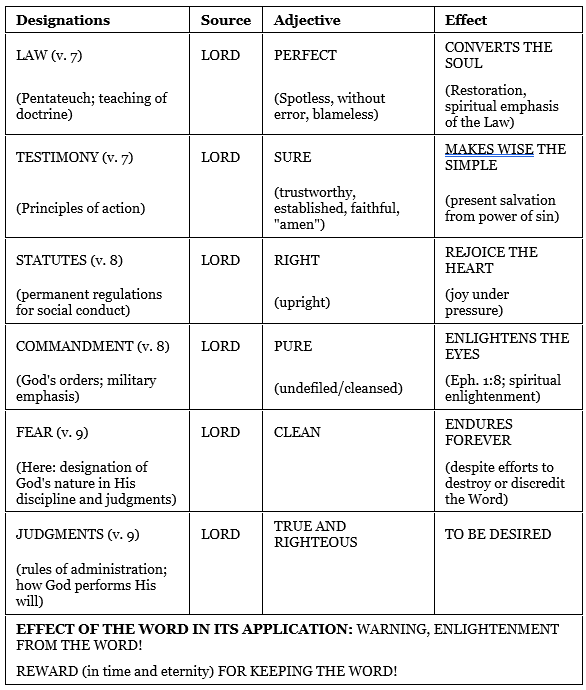
Our main objective for this lesson is to teach HOW TO CHART A PASSAGE. We will concentrate on Psalm 19, verses 7 through 10a. Let me alert you to the characteristics of the Word and its effect on the believer. You may wish to put that title above your chart, along with the pertinent reference.
A. PROCEDURE
- Divide a blank page into the required number of columns! Here we need four, two wider columns on the left and right of the page, two narrower ones in the center.
- Head columns with chosen titles! For our purpose, we will use the following, DESIGNATIONS, SOURCE, ADJECTIVE and EFFECT. After I give you the first line of this chart you will find it easy enough to fill in the remainder. Last of all, I will help you with the application. Do not dispose of your chart; we will need it in order to fill in the interpretation given in the next lesson.
(SEE COMPLETED CHART BELOW.)
B. FINDINGS
(check chart below against your work)
III. APPLYING A PASSAGE
The correct application is found in the impact of the Word on your life. We know what the Psalm meant to David, but what does it mean to you and to me? How would you apply the first six verses? I feel that the application is obvious: If nature can witness to the sovereignty, power and faithfulness of God, how much more so should I!!
Secondly, Am I availing myself of the effect of the Word? Am I allowing it to leave an impact on my life? Am I, in turn, an effective and effectual witness?
Thirdly, Do my life and lips reflect the glory of God in a transformed lifestyle? I pray they do, for only then will the "meditations of our hearts and the words of our mouths be acceptable to God our redeemer" (Psa. 19:14).
CHART 1
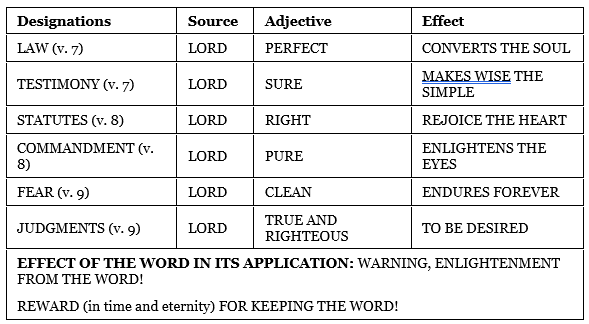
CHART 2
PRACTICAL EXERCISES
Lesson 4
Following your instructions from Lesson 4, as well as the guidelines set up in Psalm 19, study and then outline, chart, and apply Psalm 1. Work from "scratch," disregarding any notes you might have on that Psalm.
GENERAL OUTLINE:
CHART: